
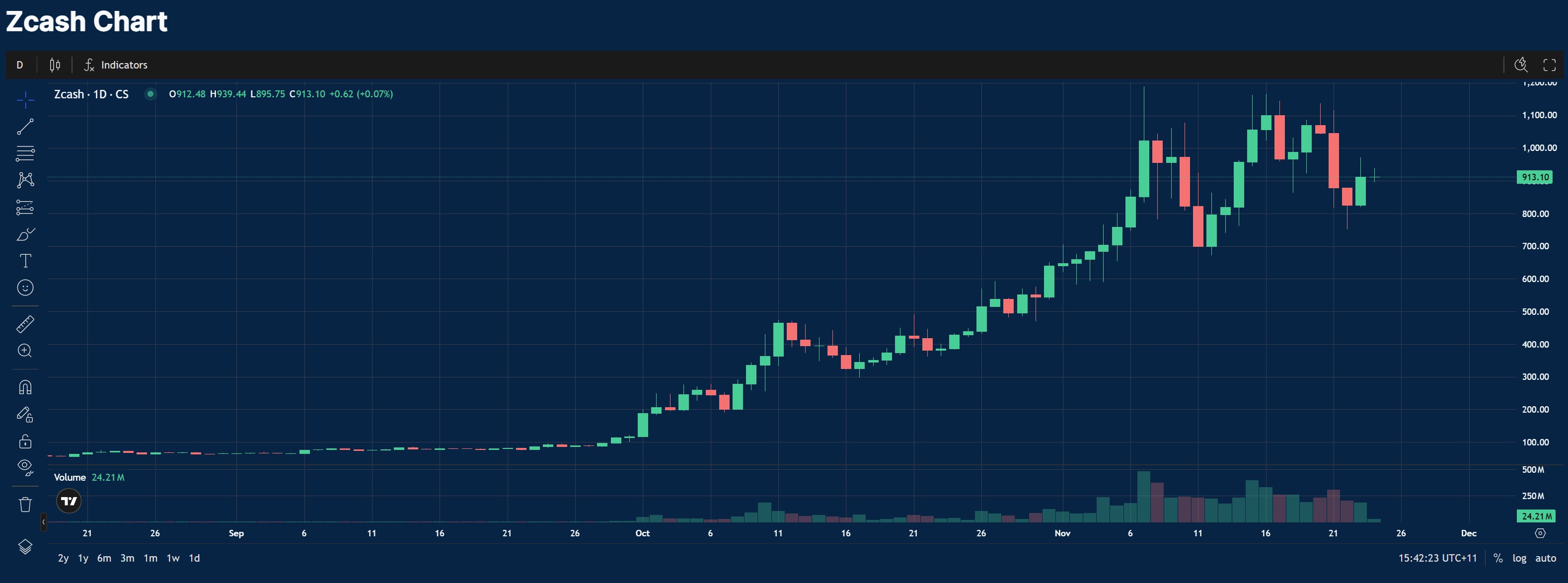
Zcash has exploded while Bitcoin crawls. Even without arguing exact multiples, the chart speaks for itself. That alone was enough to spook analysts like Bloomberg’s Eric Balchunas who warned that Zcash could split the support Bitcoin relies on. He compared it to a political spoiler. What he meant was that privacy gaining momentum again threatens the institutional dream of Bitcoin as a compliant, trackable, surveillance friendly asset. The timing is perfect for Zcash and terrible for the Bitcoin priesthood.
Winklevoss backed Cypherpunk Technologies doubled down. They added 18 million dollars worth of ZEC in November bringing their stash to 233,644 coins or 1.43 percent of the entire circulating supply. They call ZEC censorship resistant because it actually is. The privacy crowd sees zero knowledge proofs as a path back to the cypherpunk roots that surveillance culture tried to smother. Bitcoin maximalists are furious and calling it a pump and dump. They cannot stomach the idea that users might want privacy built in instead of relying on external mixers that regulators can choke out at will.
Analysts yelling about hype and fake news are missing the real story. Zcash is running because people are finally seeing how much blockchain data is harvested, indexed and sold to governments and banks. Zcash is a network that refuses to play along. Its shielded pool hides sender, receiver and amount at the protocol level, not through add on tools that chain analysis firms can still map. That one design choice makes it far harder to deanonymise than Bitcoin mixers or half baked privacy layers. Arthur Hayes already holds it and calls it a necessary complement to Bitcoin. Privacy advocates see it as Bitcoin with encryption. Institutions want crypto they can watch and score. Zcash is a direct attack on that fantasy.