
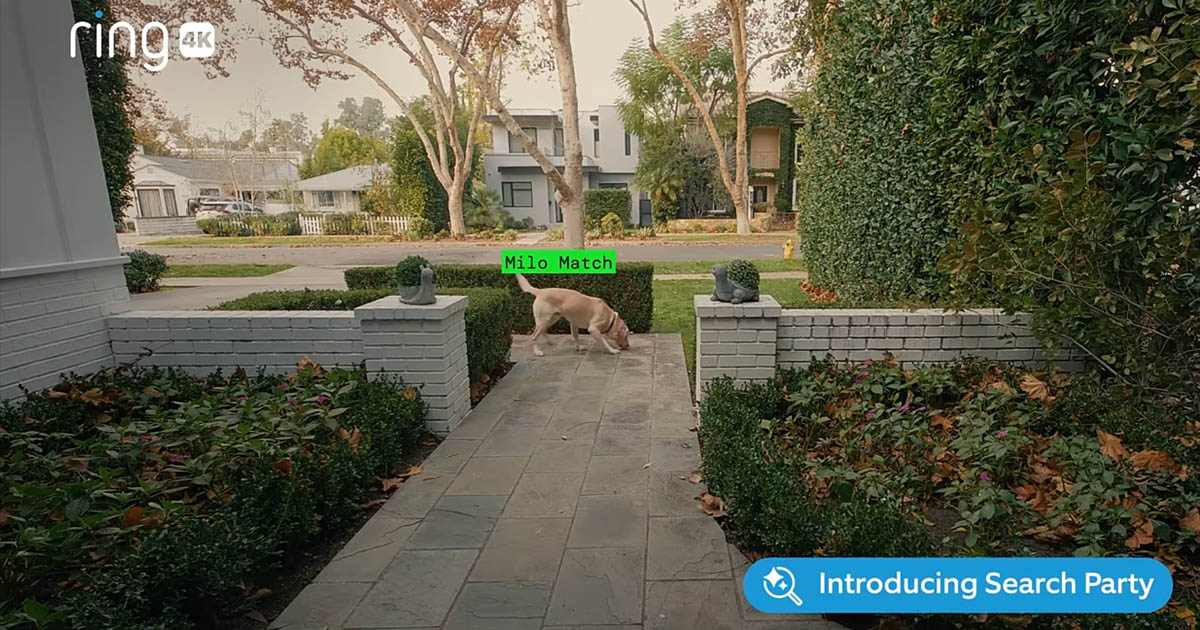
Search Party is a neighbourhood-scale AI scanning network. Amazon announced it during the Super Bowl with footage of lost dogs and reunited families. The product description buried the technical reality: every participating Ring camera in your area automatically scans for targets and reports matches to a central system without the camera owner initiating anything.
The feature works like this. A user posts a missing dog alert through the Ring app. Every enabled outdoor camera in the surrounding area begins scanning footage for animals matching the description. Camera owners receive alerts when the system flags a match and can choose whether to share the clip. The camera owner does not choose whether to participate in the scanning. That happens automatically.
Ring already operates a process allowing police to obtain footage without a warrant under situations departments classify as emergencies. Search Party extends that infrastructure. The same object recognition that identifies a dog by color and shape supports license plate reading, facial recognition, and searches based on physical description. These are not future capabilities Ring is building toward. They exist in the current system.
Ring's police partnerships provide the broader context Amazon avoided mentioning during prime time. The company maintains active partnerships with Flock Safety, which operates license plate reader networks used by law enforcement across the US, and Axon, which makes police body cameras, tasers, and evidence management software. These partnerships expand access to Ring footage, metadata, and automated analysis across jurisdictions. Search Party adds another layer of automated scanning to infrastructure already feeding data into law enforcement systems.
Amazon paired the Search Party launch with a $1 million initiative to install Ring systems in more than 4,000 animal shelters. Every shelter installation extends the network. Every new camera added under the banner of animal welfare is a camera participating in automated scanning the next time a Search Party alert goes out. Ring also typically enables new AI features by default. Users who want to opt out are responsible for finding the controls themselves.
The company's beta Familiar Faces feature, which received no mention during the Super Bowl broadcast, uses Ring AI to recognize specific people and alert camera owners when those individuals appear on camera. It works with continuous recording capturing both audio and video. The infrastructure supporting Familiar Faces and Search Party is the same infrastructure.
About 30% of US households have video doorbell cameras. Ring is among the most common brands. That density means Search Party has immediate reach across daily movement in American neighbourhoods. The network does not require majority participation to be effective. It requires enough cameras at enough intersections to track movement between them.
Amazon framed Search Party as a community upgrade. A calm voice. A lost dog. A founder talking about driving up and down the street shouting a pet's name. The tone was chosen carefully for the largest television audience of the year. The same company runs active partnerships with police departments and surveillance firms, enables AI scanning by default, and allows law enforcement warrant-free footage access under emergency classifications departments define themselves.
Ring says privacy remains under user control. Camera owners can ignore alerts or decline to share footage. That control exists inside a system Ring designs, updates, and expands unilaterally. What gets scanned, what gets flagged, what gets retained, and who gets access are not decisions camera owners make. They decide whether to share a clip after the scanning has already happened.
Surveillance infrastructure does not announce itself as surveillance infrastructure. It announces itself as a lost dog feature, a safety upgrade, a neighbourhood community tool. The technical capabilities and the institutional partnerships exist regardless of how the launch is framed. Search Party will find lost dogs. The network scanning for them was already there.
Blackout VPN exists because privacy is a right. Your first name is too much information for us.
Keep learning
FAQ
What is Ring Search Party?
Search Party is a Ring feature that automatically scans every enabled outdoor camera in an area when a missing pet alert is posted. Camera owners receive alerts when the system flags a match but do not choose whether their camera participates in the scanning. That happens automatically.
Can Ring cameras be used for facial recognition?
Yes. Ring's beta Familiar Faces feature uses AI to recognize specific people and alert camera owners when those individuals appear. The same object recognition infrastructure supports license plate reading and searches based on physical description.
Does Ring share footage with police?
Ring operates a process allowing police to obtain footage without a warrant under situations departments classify as emergencies. The company also maintains partnerships with Flock Safety and Axon, expanding access to footage, metadata, and automated analysis across jurisdictions.
How widespread is Ring's camera network?
About 30% of US households have video doorbell cameras with Ring among the most common brands. Amazon also launched a $1 million initiative to install Ring systems in more than 4,000 animal shelters, further extending the network.
Are Ring's AI features enabled by default?
Yes. Ring typically enables new AI features by default. Users who want to opt out are responsible for finding the controls themselves. The Familiar Faces facial recognition feature received no mention during the Super Bowl broadcast that introduced Search Party.